

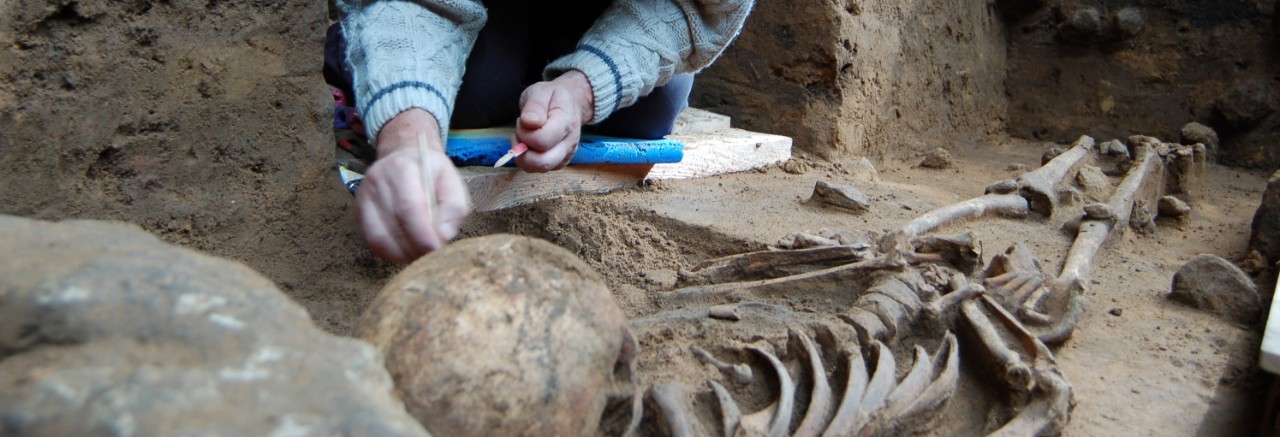
Student job opportunity
Project title:
Archaeological excavations on the secondary axis of Oppidum Titelberg's public space
Location: next to Pétange, Luxembourg (https://g-o.lu/3/Igf7R)
Project length: 2027-2032
Time span of season 2027: 28 June to 31 August 2027
Application deadline 2027: 1 March 2027
Type of activity: student job
Project lead: Dr. Iliya HADZHIPETKOV

About the site
Titelberg is one of the best-known sites in the Great Region with regard to the transition between the La Tène and Gallo-Roman period periods. The Oppidum was founded during the fourth quarter of the 2nd century BC on the site of an existing Early Iron Age fortification. It covered an area of more than 50 hectares and comprised three key zones: a public space, a residential district, and a zone reserved for Mediterranean merchants.
Following Caesar's conquests, the site lost gradually its original significance and evolved into a Roman-style village. This vicus came to an end around the end of the 3rd century AD.

Further on the topic:
METZLER J. 1995. Das treverische Oppidum auf dem Titelberg
METZLER-ZENS N., METZLER J., MENIEL P., BIS R., GAENG C., VILLEMEUR I. 1999. Lamadelaine. Une nécropole de l'oppidum du Titelberg
GAENG C., METZLER J., GASPAR N., HOMAN L. 2014. L'oppidum gaulois du Titelberg
METZLER J., GAENG C., MENIEL P., DARBLADE-AUDOIN M.-P., GASPAR N., HOMAN L., KREMER G., METZLER-ZENS N. 2016. L'espace public du Titelberg
METZLER J., GAENG C., MÉNIEL P., GASPAR N., HOMAN L., TRETOLA MARTINEZ D. C. 2018. Comptoir commercial italique et occupation militaire romaine dans l’oppidum du Titelberg. Un état de la recherche (2017)

Project Description
The project aims to gather more information about earlier phases of the site, including the Neolithic and Iron Age periods, as well as the transition to the Gallo-Roman period. The chosen area covers the western part of the secondary axis that ran between the western gateway of the public space and the eastern main gate of the oppidum. The available data suggests that this area was used until the end of the 1st century BC and was less affected by later activities.
Organisation of the working day
The working day will start at around 7 am and last eight hours. Team members will participate in excavations and the documentation of features found, as well as the initial processing and cataloguing of artefacts. Depending on the volume of finds and weather conditions, the focus of the work may be on fieldwork or laboratory work.
Participants will have weekends off.


Room and Board Arrangements
INRA will organise suitable sleeping accommodation for the participant from abroad
The monthly salary for a student job in Luxembourg is around €2000-2200, but
the first payment usually takes several months and is processed directly through the Ministry in charge of the civil service
Please note that non-Luxembourg residents need to send in their contract ahead of time
Find out more about living in Luxembourg :
Requirements
- full-time student in Erasmus+ Programme Countries (or finished less than four months ago)
- age between 18 and 27
- terrain experience and deep interest towards the problems of the time span between the 2nd century BC and the 1st century AD
- good knowledge in English, German or French
- work in team
As priority can be seen
- specialisation (ceramology, paleometallurgy, archaeozoology, numismatic, etc.)
- participation in scientific conferences, projects and publications
- Driver's licence, personal car and willingness to transport your comrades
To apply
Please email (subject: Student job Titleberg 2027) us to etudiant@inra.etat.lu with the following data:
- information about your time availability
- CV
- motivation later
- a recommendation from a professor or someone you have worked with
For further information